

Introduction
The idea of prompt to game is changing the way games are created. Instead of writing code, designing levels manually, or spending months on development, users can now simply describe their idea in text—and artificial intelligence transforms it into a playable game.
This new approach is powered by AI game creation tools such as SeaVerse AI, which convert natural language prompts into game worlds, characters, mechanics, and interactive experiences. It makes game development faster, easier, and accessible to everyone.
What Is Prompt to Game?
Prompt to game refers to the process of generating a complete or semi-complete video game using a text description. The user provides a prompt such as:
“Create a survival game on a deserted island with crafting, enemies, and exploration.”
The AI then interprets this request and builds a working game prototype including environment, gameplay systems, and objectives.
This removes the need for traditional coding and allows creativity to become the main focus.
How Prompt to Game Works
AI systems behind prompt-based game generation use machine learning models trained on thousands of games, mechanics, and design patterns.
Here’s how the process typically works:
Step 1: User Input
The user writes a description of the game idea in simple language.
Step 2: AI Interpretation
The system analyzes the prompt and identifies key elements such as genre, mechanics, characters, and environment.
Step 3: Game Generation
The AI automatically builds:
- Game world or map
- Player character
- NPCs and enemies
- Objectives and missions
- Basic physics and rules
Step 4: Customization
Users can modify difficulty, visuals, controls, and gameplay features.
Step 5: Playable Output
The result is a working prototype that can be tested immediately.
Examples of Game Prompts
Here are some simple prompts that can generate games:
- “Create a racing game with futuristic cars and neon tracks.”
- “Build a fantasy RPG with magic spells and dungeon exploration.”
- “Make a puzzle game where players match shapes to unlock doors.”
- “Generate a zombie survival game in a city environment.”
Each prompt leads to a different style of game based on AI interpretation.
Role of SeaVerse AI in Prompt to Game
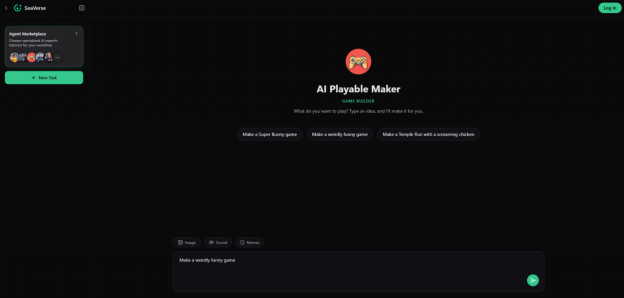
SeaVerse AI is one of the platforms helping users explore prompt-based game creation. It allows creators to:
- Turn text ideas into playable games
- Generate characters and environments automatically
- Design gameplay mechanics without coding
- Test and refine games in real time
By using SeaVerse AI, users can quickly transform imagination into interactive experiences.
Text to Game: Turning Ideas into Playable Worlds with AI
Introduction
Text to game is one of the most exciting innovations in modern game development. It allows users to create fully playable games simply by describing them in words. Instead of writing complex code or using advanced game engines, you can type a prompt—and artificial intelligence builds the game for you.
Platforms like SeaVerse AI are making this technology more accessible, enabling beginners and professionals to transform ideas into interactive experiences within minutes.
What Is Text to Game?
Text to game is an AI-powered process where a written description is converted into a working video game. The user provides instructions such as genre, characters, environment, and gameplay style.
For example:
“Create a fantasy adventure game where a hero explores caves, fights monsters, and collects treasures.”
The AI then generates:
- Game environment
- Player character
- Enemies or NPCs
- Missions and objectives
- Basic gameplay mechanics
This makes game creation faster and more accessible than ever before.
Challenges of Text to Game Systems
Despite its power, text-to-game technology still has limitations:
- Complex mechanics may require manual adjustments
- AI-generated graphics may need refinement
- Large-scale games can be harder to fully automate
- Multiplayer features may be limited in early versions
However, these challenges are improving rapidly as AI evolves.
Future of Text to Game
The future of text to game technology is extremely promising. In the coming years, users may be able to:
- Generate full 3D games from a single sentence
- Create multiplayer worlds instantly
- Add voice commands for game creation
- Automatically balance gameplay using AI
- Collaborate with AI in real time for design and testing
Platforms like SeaVerse AI are expected to play a major role in this transformation.
Conclusion
Text to game technology is changing the gaming industry by turning simple descriptions into fully playable experiences. It removes the need for coding and allows anyone to become a game creator.
With platforms like SeaVerse AI, users can quickly generate, customize, and share games using only text prompts. As artificial intelligence continues to grow, text-to-game systems will become even more powerful, shaping the future of game development and interactive entertainment.